
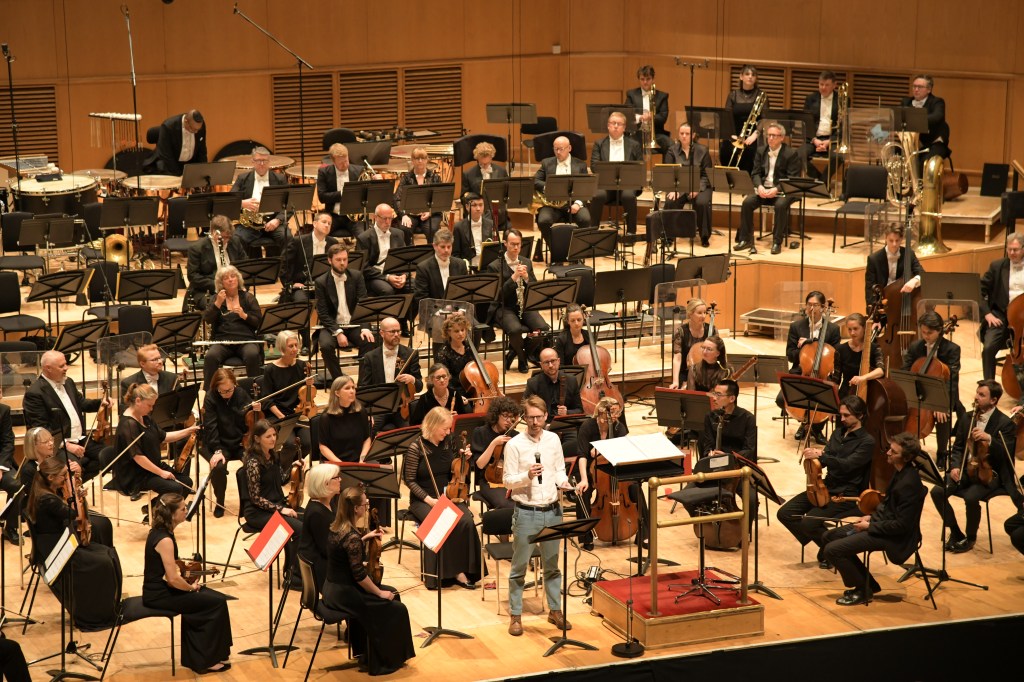
I spoke to Continuo Connect about my piece Hidden Polyphony for the RSNO, Dunedin Consort and Anna Dennis.
For critical reaction to the work, see my other post.
Given your background in contemporary composition, what first drew you to explore Scottish Renaissance music?
I was giving a class at the University of Edinburgh, and Dr James Cook came in to do a talk on his research. At the time, this was focused on looking at written sources and seeing what descriptions of music could be found. It is hard to overestimate how little actual music survives from much of this period, so James was looking at wills and other documents to see what people said about the music. From this, it was clear that there was a lot of very sophisticated music-making going on. One of the wills actually made its way into the final piece: Christine Geddes asks that a mass be said to save the souls of her and all her loved ones, showing the importance of music in negotiating the present and the afterlife during this period.
Why is your work called ‘Hidden Polyphony’?
The first, most literal, meaning refers to the fact that during this period, a good deal of polyphonic music was performed in Scotland, but it is obscure to us because of a lack of sources and, quite probably, because of a significant tradition of extemporisation, which left no written trace.
My piece also makes use of quite a lot of original material, which is fairly well ‘hidden’ at first, but emerges over the course of the piece. Finally, this sense that music was used to create impressions of heaven, and to ward off the threat of purgatory or hell, made me think of the concealed worlds that the human soul was seen to pick its way between.
Did you find any surprising parallels between Renaissance music and contemporary music?
There is a lingering notion that contemporary music is particularly obsessed with compositional craft and complex system, so I really enjoyed exploring the ways in which Renaissance composers were interested in equally obscure feats of technical mastery. There was a sense of pieces being part of intellectual enquiry, as well as composers challenging themselves to, for example, write multiple canons on a theme or pieces that can be read in multiple times.
What do you think is so progressive about the harmonic texture in Robert Carver’s music?
My piece makes several references to these huge chords that come in Carver’s O bone jesu, which, incidentally, I believe to be the greatest surviving piece ever written in Scotland. In a way, these chords are quite simple, but something in the sonority of the massed parts and the way they move individually creates something really special that kept going round and round my head as I was writing.
Any discoveries along the research and creative process?
My dad lent me a book on the Aberdeen Breviary, which is a collection of liturgical materials for Scottish saints. That book mentioned that in the so-called ‘Glamis’ copy of that source, there is one fragment of music. I took this fragment to James and he said that no one had looked into it in any great depth. Enter David Coney, a PhD student at Edinburgh, who identified that the written fragment fits a with a particular chant (‘Cultor Dei’), from which we can glean a fair amount about how they approached this material at the time. They (along with Paul Newton-Jackson) have since published their research on this book and the fragment, which is now an important source in Scottish 16th-century music: I’d recommend having a read! It was a real thrill contributing a small bit to the study of music of the period. My dad, Donald – a huge advocate for Scottish history and culture – is also the dedicatee of the piece.
 Neil Tòmas Smith
Leave a comment